
What are ratios, rates, and proportions?
A ratio is a comparison of two quantities. The ratio of to b can be expressed as or a/b.
A proportion is an equality of two ratios. We write proportions to help us find equivalent ratios and solve for unknown quantities.
A rate is the quotient of a ratio where the quantities have different units.
In this lesson, we’ll:
- Learn to convert between part-to-part and part-to-whole ratios
- Practice setting up proportions to solve for unknown quantities
- Use rates to predict unknown values
You can learn anything. Let’s do this!!
Example: There are students at Du Bois Academy. If the student-to-teacher ratio is 17:2, how many teachers are there?
(Ans): We can set up a proportional relationship using equivalent student-to-teacher ratios. If we plug in known values and use x to represent the number of teachers:
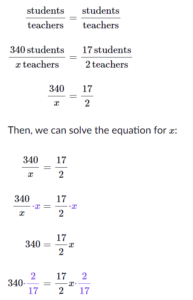
40 = x.
What are graphs of linear equations and functions questions?
Graphs of linear equations and functions questions deal with linear equations and functions and their graphs in the -plane. For example, the graph of y = 2x-1 is shown below.
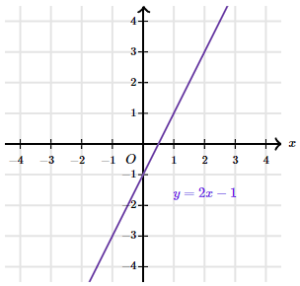
An equation in function notation,f(x) = 2x – 1, can also represent this line.
In this lesson, we’ll learn to:
- Identify features of linear graphs from their equations
- Write linear equations based on graphical features
- Determine the equations of parallel and perpendicular lines
You can learn anything. Let’s do this!!
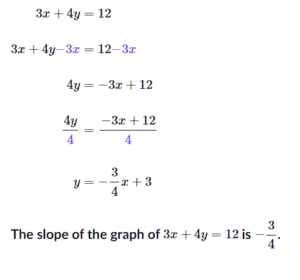
Example: What is the slope of the graph of ?
With OPUS by your side, you're on track for SAT success. Good luck, you've got this!!!!