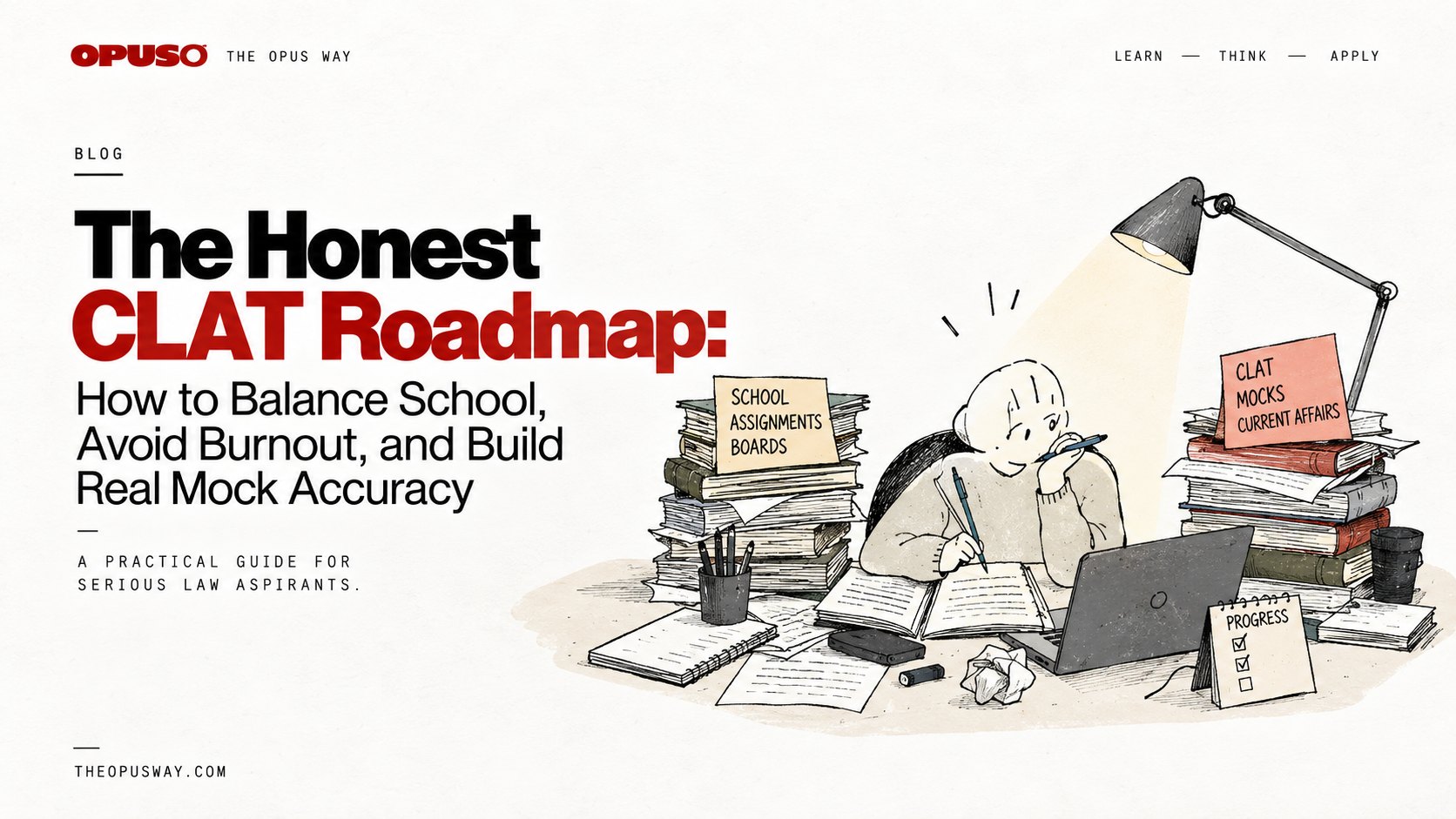
Every year, thousands of law aspirants fall into the exact same trap: downloading hundreds of PDFs from Telegram, staying up until 2 AM doing repetitive homework sheets, and watching their mock scores plateau at the 60-mark ceiling.
CLAT is not an exam of rote memory. It is an aptitude test of reading speed, critical reasoning, and disciplined test-taking temperament.
Whether you are starting early in Class 11, balancing your preparation with Class 12 board exams, or keeping backup avenues like CUET open, here is an honest, no-fluff guide to navigating the journey—and how we solve these hurdles at The Opus Way.
1. When Should You Start? (The Class 11 Advantage)
A common worry among high school students and parents is whether Class 11 is "too early" or "too late."
The reality: Class 11 is the sweet spot.
CLAT tests your ability to read and analyze dense, 450-word passages across five distinct sections under strict time constraints. Reading stamina of 350+ words per minute cannot be crammed in a two-month crash course.
Starting in Class 11 gives you the runway to:
- Build effortless reading endurance without late-night cramming.
- Internalize core critical reasoning mechanics (identifying premises, assumptions, and logical fallacies).
- Keep your Class 12 board preparation completely stress-free.
How Opus Solves This:
Our two-year foundational batches are designed around school calendars. We focus on building cognitive aptitude and comprehension stamina gradually, ensuring school grades never take a backseat while long-term CLAT readiness becomes second nature.
2. The Coaching Burnout Trap: Volume vs. Aptitude
The biggest reason aspirants burn out isn't the difficulty of the syllabus—it is generic coaching busywork.
Traditional mass-market institutes often treat entrance prep like rote school tuition, assigning hundreds of practice questions without diagnostic feedback. For a student managing high school projects and exams, this creates fatigue without moving the mock needle.
How to Fix Your Routine:
- Ditch the busywork: Solving 200 unreviewed questions only reinforces bad habits.
- Master reasoning mechanics: Understand why an author used a specific premise or how an option sets an elimination trap.
- Choose high-yield learning environments: Prioritize live passage deconstruction over passive note-taking.
How Opus Solves This:
We strictly cap our batch sizes to maintain mentorship over scale. Instead of drowning students in endless worksheets, our faculty—led directly by top NLU alumni and rankers (including CLAT AIR 6 and AIR 46)—walk students through live deconstructions of dense passages, teaching precise elimination strategies that save time and eliminate negative marking.
3. Can You Balance CLAT with CUET and Board Exams?
Many students hesitate to prepare for CLAT because they worry about managing board exams or alternate career avenues like CUET.
These exams actually reinforce each other when approached with the right framework:
| Exam Area | What CLAT Tests | What CUET / Boards Test | The Synergy |
|---|---|---|---|
| English & Comprehension | Complex tone, inference, context | Grammar, vocabulary, structure | CLAT’s passage reading makes CUET English feel effortless. |
| Logical Reasoning | Argument structure & critical logic | General mental ability & reasoning | CLAT critical reasoning fully covers the CUET General Test. |
| Domain Subjects | N/A | Class 12 NCERT textbook syllabus | School prep handles your board percentages and CUET domain scores. |
How Opus Solves This:
Our curriculum is built to strengthen core analytical reading and logic. By sharpening your ability to process complex information rapidly, your board exam reading speed and CUET preparation naturally become sharper and faster, eliminating the need for separate, disjointed coaching programs.
4. Self-Study vs. Mass Coaching: The Diagnostic Gap
Self-study is great for discipline, but competitive aptitude exams present a specific hurdle: reasoning blind spots.
- The Self-Study Bottleneck: You know an answer is wrong, but standard answer keys rarely explain the faulty thinking pattern that led you to choose it.
- The Mass Coaching Bottleneck: In 100+ student lecture halls, individual errors get lost in the crowd.
- The Solution: Iterative mock post-mortems and targeted error analysis.
How Opus Solves This:
At Opus, test prep is a continuous feedback loop. Through our diagnostic review sessions and Opus Connect clinics, mentors sit with students to conduct deep-dive mock post-mortems. We pinpoint whether an error stemmed from reading fatigue, a misidentified premise, or falling for distractor options, turning score drops into actionable data.
5. The Blueprint of a 2-Hour Daily Routine
You do not need to study 8 hours a day to crack a top National Law University. A consistent 2-to-3-hour framework produces consistent, compounding results:
- Morning Reading (40 mins): Read 2 editorial pieces from The Hindu or The Indian Express. Summarize the central argument in two sentences and identify unstated assumptions.
- Targeted Sectional Drills (45 mins): Alternate between GMAT-style critical reasoning, legal principle application, and Data Interpretation sets.
- Current Affairs Consolidation (35 mins): Focus on analytical monthly roundups and issue-based timelines rather than memorizing isolated single-line facts.
- Weekend Mock Review (3 hours): Take one timed mock test. Spend the remaining time categorizing errors into comprehension misses, elimination traps, or time pressure.
Why Choose The Opus Way?
An entrance exam is a gatekeeper, not the final destination. At The Opus Way, we refuse the factory coaching model. We don't just drill students to clear a cut-off; we build the critical thinking, cognitive agility, and academic resilience required to thrive at India's top law schools and beyond.
- Top NLU Mentors: Learn directly from mentors who have aced the exam and graduated from premier law universities.
- Small Cohorts & Personal Accountability: Every student’s strengths, plateaus, and error trends are actively tracked.
- Diagnostic-First Approach: Real-time feedback loops replace passive lecturing.
Ready to start your CLAT journey with clarity?
Book a diagnostic session and 1-on-1 counseling consultation with our mentors to map out your personalized roadmap to a top NLU seat.
No Legal Background Needed: CLAT tests reading speed and critical thinking—not rote memorization of law sections or heavy legal jargon.
Class 11 Is the Sweet Spot: Starting early builds the required 350+ words-per-minute reading stamina without clashing with Class 12 board preparation.
More Practice Higher Scores: Score plateaus happen when students solve hundreds of questions without diagnosing why they make mistakes.
School & CUET Synergy: CLAT’s comprehension and critical logic training directly strengthens school English and the CUET General Test.
2–3 Focused Hours Are Enough: Consistent daily editorial reading, targeted logic drills, and weekly mock analysis beat exhausting 8-hour cram sessions.
The Opus Edge: Small cohorts, 1-on-1 mock error analysis, and direct mentorship from top NLU rankers ensure you learn how to think, not just how to guess.
es. CLAT is an aptitude exam, not a law test. It does not require prior legal knowledge or rote memorization of Indian Penal Code sections. It evaluates reading speed, logical reasoning, and analytical clarity. At The Opus Way, our mentors build your foundational reading stamina and logical reasoning frameworks from scratch.
core plateaus happen when students practice blindly without identifying the root cause of their errors. Through our Opus Connect clinics and personalized 1-on-1 mock post-mortems, we diagnose whether you are losing marks due to time-misallocation, reading fatigue, or trap answer choices, giving you actionable fixes for immediate score recovery.
Our batch schedules are planned around school timetables and board exam periods. The critical reading and reasoning skills you build for CLAT directly enhance your performance in Class 12 English and CUET exams, allowing you to prepare efficiently in just 2 to 3 focused hours a day.
We strictly limit our batch sizes to ensure real mentorship rather than passive mass lectures. Your mentors—including top NLU rankers—track your individual progress, understand your specific error patterns, and answer your doubts directly.
he aptitude and reasoning foundation you build at Opus covers multiple premier law entrances (such as AILET, SLAT, and MHCET) as well as the General and English sections of CUET for top central universities.
You can begin by taking a diagnostic baseline assessment and booking a 1-on-1 strategy session with our mentors to map out a personalized prep roadmap tailored to your target NLU.
Break the Plateau. Build Your Path to a Top NLU.
Stop guessing where you lose marks. Experience our diagnostic-first approach with personalized passage deconstruction, small cohorts, and 1-on-1 mentorship led by top NLU rankers. Free Diagnostic Assessment: Uncover your exact reading & reasoning blind spots. Interactive Strategy Session: Learn live elimination tactics used by CLAT AIR 6 & AIR 46. Zero Obligation: See how our mentor-led framework transforms your prep before you commit.
Start Free Trial