Introduction
A career in design lets you blend creativity with practical, technical skill — and in India, two institutes lead the field: the National Institute of Design (NID) and the National Institute of Fashion Technology (NIFT). Both are prestigious, both are competitive, but they serve different design ambitions.
If you're unsure which to aim for, this comparison covers everything that matters — their focus, campuses, entrance exams and the kind of student each suits.
About NID
Established in 1961, the National Institute of Design is India's premier institute for design education, with global recognition. NID takes a multi-disciplinary approach, spanning communication, product, interaction, textile and more — making it ideal for students who want a broad, exploratory design foundation.
NID's main campuses are in Ahmedabad, Bengaluru, Bhopal, Gandhinagar and Jorhat. Admission is through the NID DAT (Design Aptitude Test), which rewards observation, creativity and design thinking over rote knowledge.
About NIFT
Established in 1986, the National Institute of Fashion Technology is India's leading institute for fashion and lifestyle design — covering fashion, textiles, accessories, knitwear and more. With 17+ campuses across India, NIFT offers strong industry connections and a wide campus network.
Admission is through the NIFT Entrance Exam, which combines the Creative Ability Test (CAT) and the General Ability Test (GAT), and — for design programmes — a Situation Test that assesses hands-on material handling and creativity.
NID vs NIFT: Key Differences
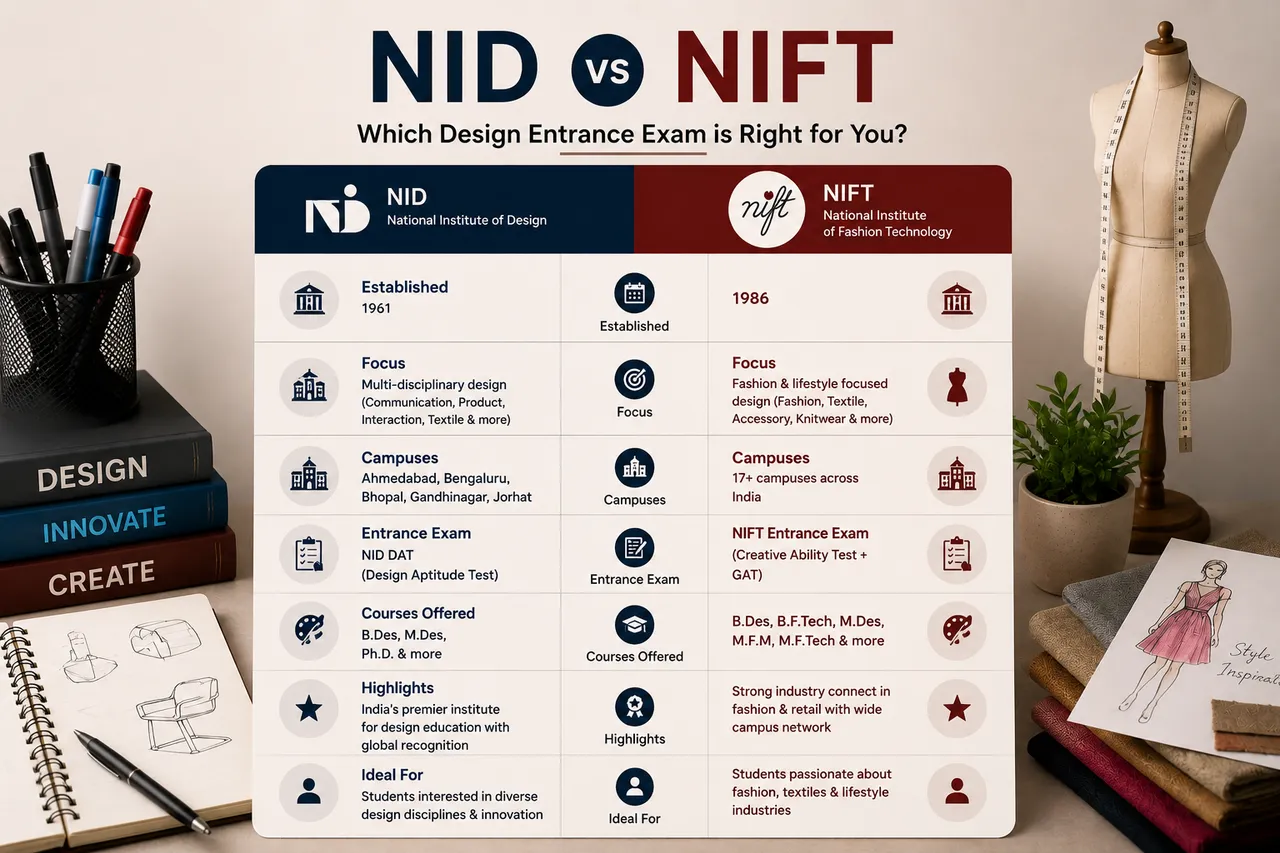
- Established: NID — 1961; NIFT — 1986.
- Focus: NID — multi-disciplinary design (communication, product, interaction, textile and more); NIFT — fashion & lifestyle design (fashion, textile, accessory, knitwear and more).
- Campuses: NID — Ahmedabad, Bengaluru, Bhopal, Gandhinagar, Jorhat; NIFT — 17+ campuses across India.
- Entrance Exam: NID — NID DAT (Design Aptitude Test); NIFT — NIFT Entrance Exam (Creative Ability Test + General Ability Test).
- Courses Offered: NID — B.Des, M.Des, Ph.D. and more; NIFT — B.Des, B.F.Tech, M.Des, M.F.M, M.F.Tech and more.
- Highlights: NID — premier design institute with global recognition; NIFT — strong industry connect in fashion & retail with a wide campus network.
- Ideal For: NID — students interested in diverse design disciplines & innovation; NIFT — students passionate about fashion, textiles & lifestyle industries.
Entrance Exam Comparison
Both exams test creativity, but in different ways. The NID DAT is design-aptitude focused — sketching, visualisation, observation and problem-solving — followed by a studio test and interview at later stages. The NIFT exam balances creative ability (CAT) with general aptitude and reasoning (GAT), and design candidates also sit a Situation Test that evaluates 3D material handling.
NID rewards original design thinking and ideation; NIFT rewards a mix of creativity and well-rounded aptitude. Many serious aspirants prepare for both, since core sketching and creativity skills carry across — but tailor your studio/situation-test practice to each exam's specific demands.
Courses Offered
- NID: Bachelor of Design (B.Des), Master of Design (M.Des), Ph.D. and more — across disciplines like product, communication, textile and interaction design.
- NIFT: B.Des, B.F.Tech, M.Des, M.F.M (Master of Fashion Management), M.F.Tech and more — spanning design, technology and management.
Which Should You Choose?
- Choose NID if you want a broad, multi-disciplinary design education and are drawn to innovation, research and exploratory design thinking.
- Choose NIFT if you're passionate about fashion, textiles and the lifestyle industry, and value strong industry connections and a wide campus network.
- Consider both if you're still exploring — the foundational creative skills overlap, so you can keep your options open early in your preparation.
Frequently Asked Questions
Neither is objectively better — they suit different goals. NID is ideal for broad, multi-disciplinary design and innovation, while NIFT is the strongest choice for fashion and lifestyle design with deep industry connections. Pick based on the kind of designer you want to become.
Yes. Core skills — sketching, visualisation, creativity and observation — overlap across both exams, so a combined foundation works well. You then tailor practice to NID's studio test and NIFT's Situation Test and GAT separately.
The NID DAT focuses on design aptitude — sketching, visualisation and problem-solving — followed by a studio test and interview. The NIFT exam combines the Creative Ability Test (CAT) and General Ability Test (GAT), with a Situation Test for design programmes.
NIFT, with 17+ campuses across India, compared with NID's main campuses in Ahmedabad, Bengaluru, Bhopal, Gandhinagar and Jorhat.
No formal design background is required. Both exams test raw creativity, observation and aptitude, which can be developed through structured practice and mentorship over a few months of focused preparation.
Ready to crack NID or NIFT?
Prepare with The Opus Way's design programme — studio practice, creative drills and mentor-led portfolio guidance. Start with a free counselling session.
Start Free Trial