Introduction
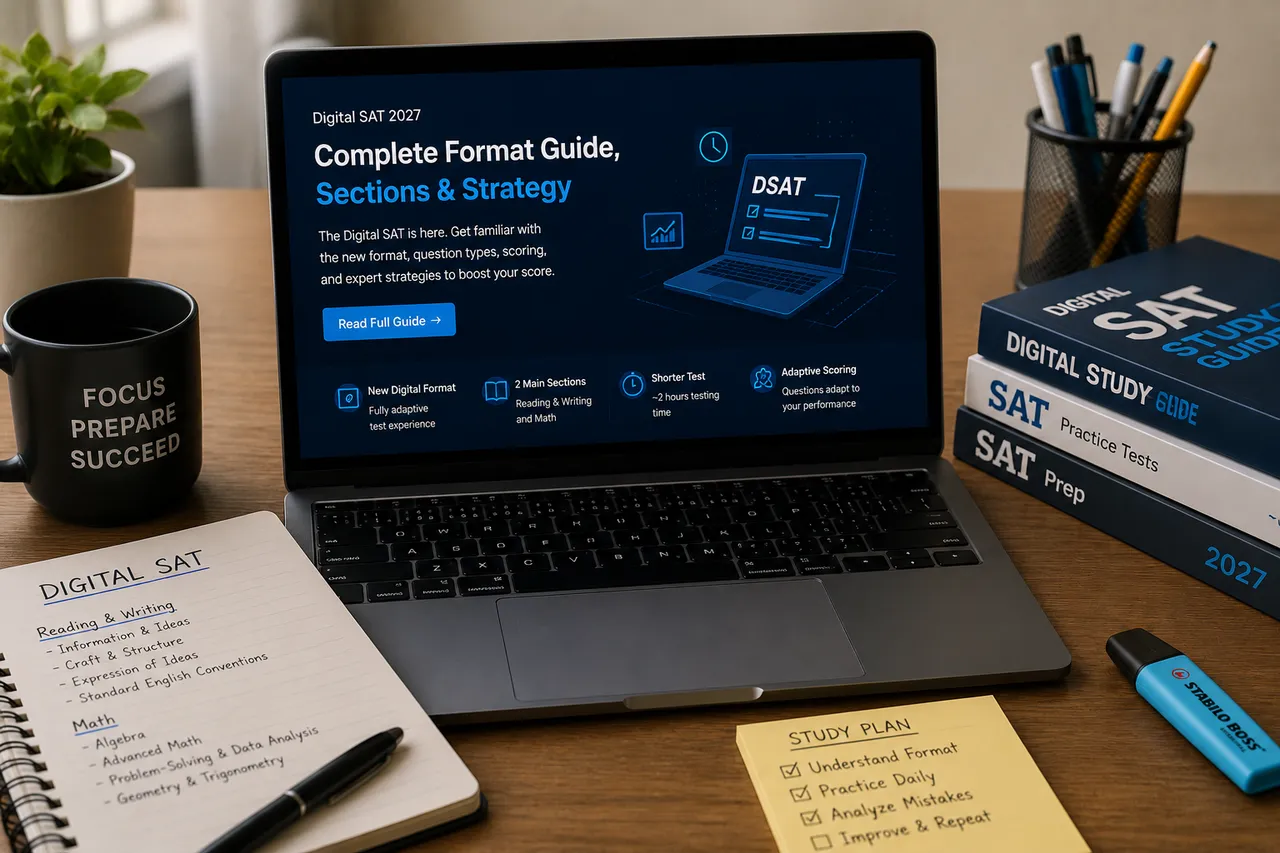
The SAT has undergone its most significant transformation since its inception. The Digital SAT, now the standard format for college admissions testing, represents a fundamental shift in how students demonstrate their college readiness. Shorter, adaptive, and computer-based, the Digital SAT is designed to be more accessible, efficient, and relevant to modern learning environments.
For students in India and around the world, understanding the new format is essential for effective preparation. This guide covers everything you need to know about the Digital SAT, from its structure and scoring to proven strategies for success.
What is the Digital SAT?
The Digital SAT is a computer-adaptive standardized test administered by the College Board for college admissions in the United States and around the world. Unlike the traditional paper-and-pencil SAT, the Digital SAT is taken on a computer or tablet using the College Board's Bluebook testing application.
The transition to digital brings several key improvements: the test is now one hour shorter, reading passages are more concise, calculators are permitted throughout the Math section, and score reports are delivered faster.
Digital SAT Format Overview
The Digital SAT is a 2-hour and 14-minute test divided into two main sections: Reading and Writing, and Math. Both sections are divided into two equal-length modules with adaptive difficulty.
Reading and Writing Section
- Total Time: 64 minutes
- Total Questions: 54 questions
- Modules: 2 modules of 32 minutes each (27 questions per module)
- Passage Length: Shorter passages (25–150 words) vs the paper SAT
- Question Types: Craft & Structure, Information & Ideas, Standard English Conventions
Math Section
- Total Time: 70 minutes
- Total Questions: 44 questions
- Modules: 2 modules of 35 minutes each (22 questions per module)
- Calculator: Permitted on all questions (built-in Desmos calculator included)
- Topics: Algebra, Advanced Math, Problem Solving & Data Analysis, Geometry
Adaptive Testing: How It Works
The most significant change in the Digital SAT is its adaptive testing model. Each section is divided into two modules. Everyone answers the same first module; your performance on it determines whether the second module is easier or harder. Perform well on Module 1 and you'll see more challenging questions in Module 2 — which unlock higher score bands.
Module 1 performance is critical — it decides your access to the high-score band. Build accuracy and speed on the first module above all else.
Digital SAT Scoring
The Digital SAT retains the familiar 1600 scoring scale, so score interpretation for college admissions remains consistent.
- Total Score: 400–1600 (sum of both section scores)
- Reading & Writing: 200–800
- Math: 200–800
- Score Reporting: Faster results, typically within 2–3 weeks
- No Wrong Answer Penalty: Only correct answers count — no negative marking
Key Differences: Digital SAT vs Paper SAT
- Duration: 2 hrs 14 min vs 3 hrs (46 minutes shorter)
- Format: Computer-based Bluebook app vs pen and paper
- Passages: Shorter (25–150 words) vs longer (500–750 words)
- Adaptivity: Multi-stage adaptive vs linear format
- Calculator: Permitted on all Math vs only some
- Results: Faster delivery (2–3 weeks vs 4–6 weeks)
How to Prepare for the Digital SAT
- Use Bluebook: Practice with official Digital SAT tests on the College Board's Bluebook platform to get comfortable with the interface and timing.
- Focus on Time Management: With shorter modules and pacing, practice completing each module within the time limit.
- Master Shorter Passages: Practice extracting key information quickly from brief texts.
- Use the Desmos Calculator: Familiarise yourself with the built-in Desmos graphing calculator.
- Strengthen Fundamentals: Build strong foundations in algebra, grammar and critical reading.
Frequently Asked Questions
The Digital SAT is a computer-based version introduced by College Board. It's shorter (2 hrs 14 min vs 3 hrs), features adaptive sections, uses shorter reading passages, allows calculator use throughout the Math section, and provides faster score results.
It takes 2 hours and 14 minutes — significantly shorter than the 3-hour paper SAT. Reading & Writing is 64 minutes (two 32-minute modules) and Math is 70 minutes (two 35-minute modules).
Not necessarily easier, but designed to be more student-friendly. The shorter format, shorter passages and built-in tools reduce stress. However, the adaptive nature means the second module can be more challenging if you perform well on the first.
Yes — on the entire Math section. The test includes a built-in Desmos graphing calculator, so you have access even if you don't bring your own.
It uses the 1600 scale (400–1600). A score above 1200 is competitive, while 1400+ is excellent for top universities. The national average typically falls around 1050.
Ready to ace the Digital SAT?
Prepare with The Opus Way's comprehensive SAT course and expert instruction. Test your readiness with a free mock test and get a personalised study plan.
Start Free Trial